Samples available UK-wide delivery
Shop by category
Pro Portal
4.6 Trustpilot 2400+ orders delivered UK-wide delivery

Your Basket

0

Your basket is empty

Browse our editorial collections and find your perfect floor.

Browse Collections
Subtotal £0.00
Shipping & discounts calculated at checkout
SSL encrypted — safe and secure
How to choose 7 min read

Slip Resistance Explained: PTV, R Values and What the Label Says

How the HSE grades slip potential from the pendulum test, what EN 13893 covers, what R11 on two of the tiles means, and which figure fits which room.

Guide type
How to choose
Reading time
7 min
Low slip potential (HSE)
36 + PTV
Sources quoted
6 published sources

Slip resistance is the characteristic people ask about for a bathroom or a kitchen, and the one with the most confused answers, because three different measurements are sold under one word. A porcelain tile listing says R11. A declaration of performance carries a slip line measured on a dry surface. A safety officer talks about a pendulum test value. None of them converts into the others, and a floor chosen on the wrong one can be right on paper and wrong on the day. This guide sets out what each figure measures and which one is written for the room you are flooring.

1/ 9
01

The pendulum test: how the HSE grades slip potential

The Health and Safety Executive grades pedestrian slip potential from the pendulum test value, PTV, obtained with the pendulum coefficient-of-friction test that is the subject of BS 7976 Parts 1 to 3. The grading is in three bands: a PTV of 36 or above is low slip potential, 25 to 35 is moderate, and 0 to 24 is high. The pendulum swings a rubber slider across the surface and the value is read off a scale; the test can be run wet as well as dry, which is why it is the measurement used where floors get wet in use and why it is the figure a specification for a public building or a workplace is written around.

For a home the value is rarely quoted on a product listing, and the HSE's bands are written for workplaces rather than private bathrooms. What they give a domestic buyer is a scale to ask about: a floor sold for wet areas with a published wet PTV is making a testable claim; a floor sold as "slip resistant" without a figure is not.

02

The declaration's slip line: EN 13893, dry only

Under EN 14041, slip resistance is one of the essential characteristics a resilient, laminate or textile floor covering declares on its declaration of performance. The method behind it is EN 13893, which measures the dynamic coefficient of friction of a floor covering walked on with shoes, and which measures on dry surfaces only. So the line on the declaration answers one question, whether a dry floor of this kind is slippery underfoot, and it answers nothing about the same floor with water on it. Reading a declared dry-friction figure as a promise for a wet floor is the commonest mistake on this subject, and the declaration of performance guide covers what the rest of that document does and does not say.

See also
03

The R value on a tile

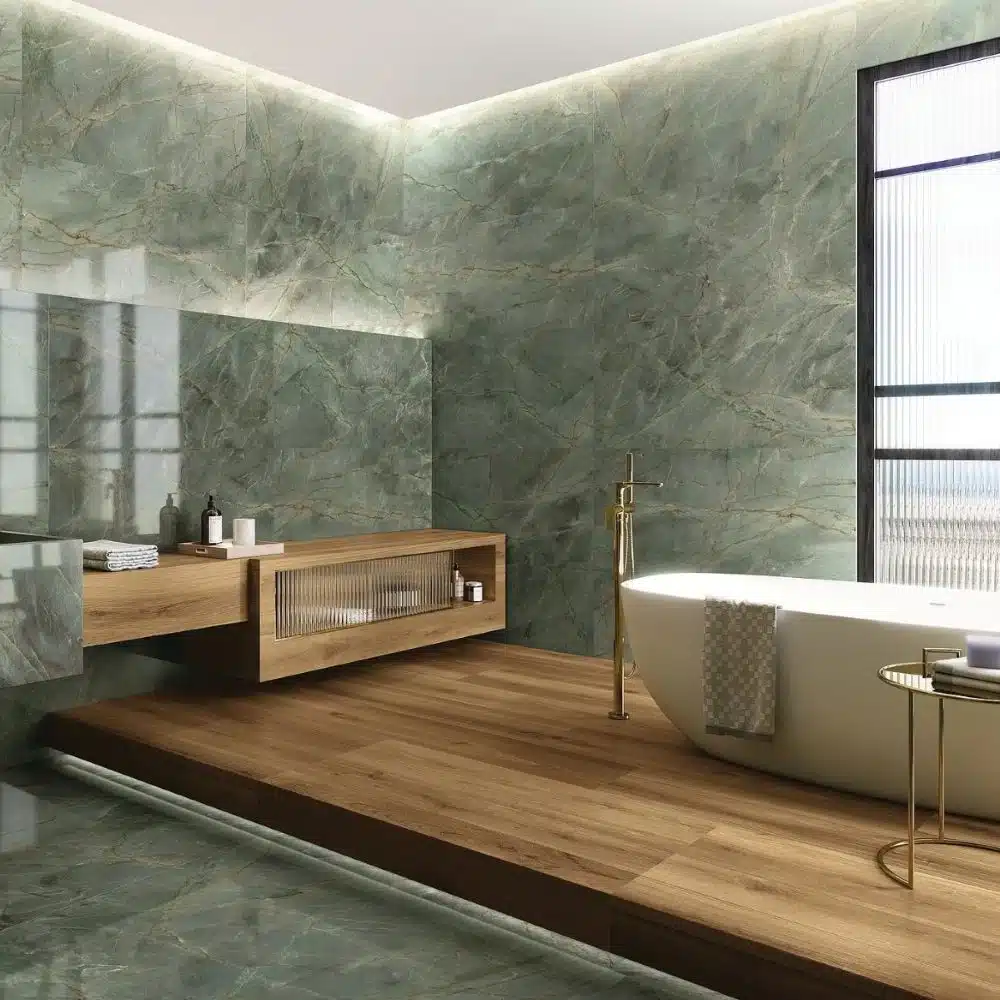
Two of the eleven porcelain tiles in the range, the Wabi Bianco and Wabi Sabbia lappato tiles, list an R11 slip resistance. The R scale comes from a different method again, a ramp test rather than a pendulum, and there is no conversion between an R class and a PTV. What a buyer can take from it is a relative statement: within the R scale, a higher class is a more slip-resistant surface. What a buyer cannot take from it is a wet PTV, because the tile was not tested that way, and a bathroom specification that asks for a pendulum value should be answered with a pendulum value.

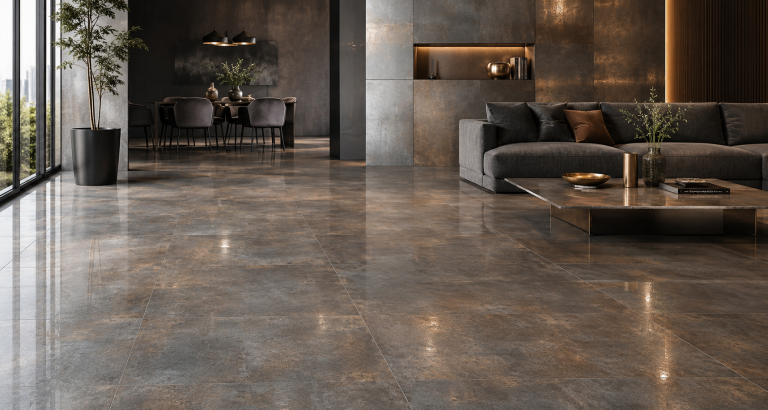
The other nine tiles list no slip figure. That is not a mark against them; it is the manufacturer declining to make a claim. Polished porcelain, which is five of the eleven, is chosen for its surface, and a polished surface is a different proposition in a wet room from a matt or lappato one. The tile guide sets out what the tiles in the range are; this page's point is only that the slip figure, where one exists, comes from a named test and should be quoted with it.

See also
04

Surface texture and what it does

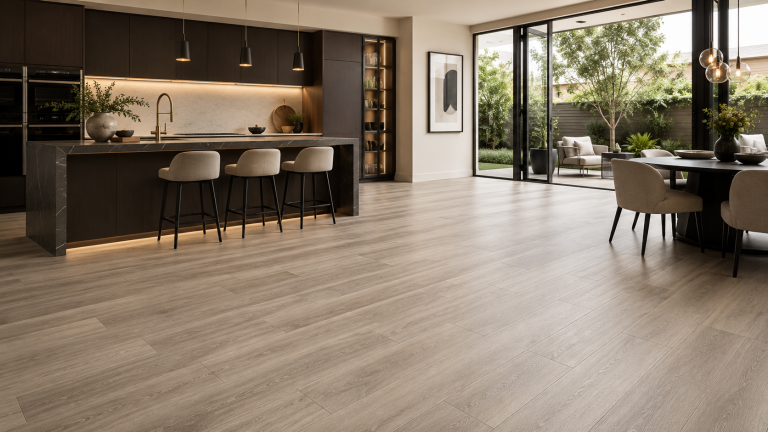
Of the 36 rigid vinyl floors in the range, 32 list a textured surface. Texture is not a slip rating and it is not on any declaration, but it is the property that the ramp and pendulum tests respond to: a surface with relief gives a shoe or a foot something to bear on when there is a film of water between them. A smooth, gloss surface has less of it. The same holds for the lappato tiles against the polished ones, and for a brushed oak against a smooth lacquered one. Texture is a reasonable thing to prefer for a room that gets wet; it is not a figure, and it should not be quoted as one.

See also
05

Which measurement for which room

Bathroom and wet room
Ask for a wet pendulum value, or an R class from a ramp test, on the tile or floor you are considering, and treat a dry-friction line on a declaration as not answering the question. A floor listed as waterproof by its maker is a statement about the material taking on water; it is a separate property from how it behaves with water on top of it.
Kitchen
Spills are the case, not standing water. A textured rigid vinyl or a matt tile gives more to bear on than a gloss finish; the use class under EN ISO 10874, 21 to 23 for domestic use, is the classification that tells you the floor is fit for the traffic, and it says nothing about slip at all.
Hallway
The risk is a wet shoe on a dry floor at the door. A mat inside the door does more for that than any rating on the floor itself.
Living rooms and bedrooms
Dry rooms, where the declared dry-friction line is the relevant one and the question rarely arises.
06

Cleaning changes the answer

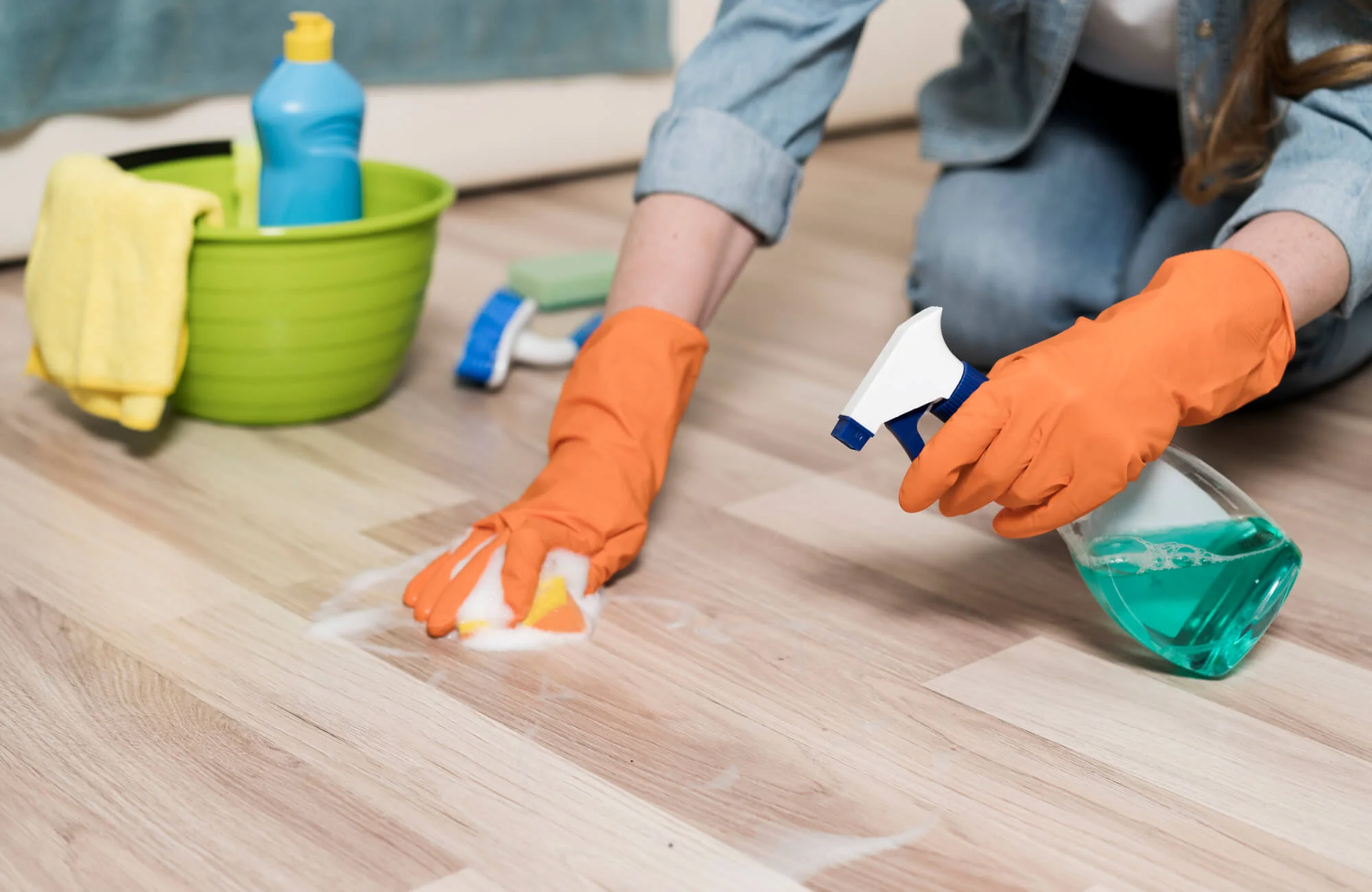
A floor's slip behaviour is not fixed at the factory. Polish, residue from the wrong cleaner and a film of soap all change the surface a foot meets, and the association that represents multilayer modular flooring makers, the MMFA, requires low-moisture cleaning and says that pooling of liquid on the floor must be avoided under all circumstances. The rigid vinyl cleaning guide and the wood floor care guide cover the methods; the point here is that a slip-resistant surface stays one only if it is cleaned in a way that leaves it as tested.

See also
07

Where laminate stands

Laminate declares its dry-friction line like any other covering under EN 14041, but its product standard, EN 13329, does not cover areas subject to frequent wetting and names bathrooms, laundry rooms and saunas. So for laminate the wet-slip question does not arise, because the wet room is not a room it is made for; the AC rating guide covers what its rating does measure.

See also
08

Common questions

What PTV counts as low slip potential?

The Health and Safety Executive grades a pendulum test value of 36 or above as low slip potential, 25 to 35 as moderate and 0 to 24 as high. The test is the pendulum coefficient-of-friction test in BS 7976 Parts 1 to 3.

Can I convert R11 into a pendulum value?

No. The R scale comes from a ramp test and the PTV from a pendulum test; they are different methods and there is no published conversion between them. Ask for the figure your specification is written around.

Does the slip line on a declaration of performance apply when the floor is wet?

No. The method behind it, EN 13893, measures the dynamic coefficient of friction on dry surfaces only. A wet-floor question needs a wet pendulum value or a ramp-test class.

Is a textured floor the same as a slip-resistant one?

Texture is the property the slip tests respond to, but it is not a rating and it is not on any declaration. Prefer texture for a room that gets wet; quote a figure only where a named test produced one.

Which rooms get wet, and how often, differs between a terrace with one bathroom and a house with three. Browse by town and region.

See also
09

What the published standards say

Each entry is quoted from its source and linked to it. The full set is in the standards reference.

Pendulum Test Value — how slip risk is assessed

HSE grades pedestrian slip potential from the pendulum test value (PTV): 0-24 is high slip potential, 25-35 moderate and 36 or above low slip potential, the pendulum coefficient-of-friction test being the subject of BS 7976 Parts 1-3.

low slip potential36 + PTV
moderate slip potential25-35 PTV
high slip potential0-24 PTV

“Table 1 Slip potential classification, based on pendulum test values (PTV) PTV High slip potential 0-24 Moderate slip potential 25-35 Low slip potential 36 +”

Source: HSE - Assessing the slip resistance of flooring (GEIS2)

BS EN 13893 — slip resistance, dry conditions

EN 13893 sets the parameters for measuring the dynamic coefficient of friction of resilient, laminate and textile floor coverings walked on with shoes; the result is a dynamic coefficient of friction and the measurement is taken on dry surfaces only.

measured quantitydynamic coefficient of friction (u)
relief floor coverings included up to displacement volume4 cm3/dm2

“This European standard specifies the parameters for the measurement of dynamic coefficient of friction (u) on surfaces of resilient, laminate and textile floor coverings, usually walked on with shoes. Reliefed floor coverings with a displacement volume <= 4 cm3/dm2 are included.”

Source: BS EN 13893:2002 - Resilient, laminate and textile floor coverings. Measurement of dynamic coefficient of friction on dry floor surfaces (British Standard)

BS EN 14041 — essential characteristics that must be declared

Under EN 14041 the essential characteristics declared for resilient, textile, laminate and modular multilayer floor coverings are reaction to fire, content of pentachlorophenol, formaldehyde emission, slip resistance, electrical behaviour (antistatic, dissipative, conductive), thermal conductivity and water-tightness. Characteristics that are not declared are shown as NPD (no performance determined).

Essential characteristic 1Reaction to fire
Essential characteristic 2Content of Pentachlorophenol
Essential characteristic 3Formaldehyd Emissions
Essential characteristic 4Slip resistance
Essential characteristic 5Electrical behavior (dissipative)
Essential characteristic 6Electrical behavior (conductive)
Essential characteristic 7Electrical behavior (antistatic)
Essential characteristic 8Thermal conductivity W/mK
Essential characteristic 9Water-tightness

“Reaction to fire | Cfl-s1 | EN 14041: 2004/AC:2006”

Source: SLAETTEN laminate flooring — Declaration of Performance, IKEA of Sweden

EN ISO 10874 — use classes

EN ISO 10874 sets out a classification of floor coverings by area and intensity of use; the classes are 21, 22 and 23 for domestic use, 31 to 34 for commercial use and 41 to 43 for industrial use.

Class 21Domestic moderate/light
Class 22Domestic general/medium
Class 23Domestic heavy
Class 31Commercial moderate
Class 32Commercial general
Class 33Commercial heavy
Class 41Industrial moderate
Class 42Industrial general
Class 43Industrial heavy

“In EN ISO 10874 a classification system for different use classes is described, with references to the relevant product standards.”

Source: How to use the Floor Covering Standard Symbols (FCSS) — EUFCA, symbols per EN 15398

Cleaning — the manufacturers’ own guidance

For multilayer modular floor coverings the MMFA requires low-moisture cleaning methods and states that pooling of liquid on the floor must be avoided under all circumstances.

“Absolutely avoid ponding in any case!”

Source: Basic cleaning — MMFA (Multilayer Modular Flooring Association)

BS EN 13329 — laminate floor coverings

BS EN 13329 specifies the characteristics, requirements and test methods for laminate floor coverings with a surface layer based on aminoplastic thermosetting resins, including requirements for marking and packaging. It also contains a classification system based on EN ISO 10874 for areas and levels of use, and it does not cover areas subject to frequent wetting such as bathrooms, laundry rooms or saunas.

“BS EN 13329 specifies characteristics, requirements, and test methods for laminate floor coverings with a surface layer based on amino plastic thermosetting resins. BS EN 13329 specifies requirements for marking and packaging.”

Source: BS EN 13329:2016+A2:2021 | 31 Oct 2021 | BSI Knowledge
Still deciding?
A sample on the floor, in the room it is for, answers most of what a description cannot.
Newsletter

New ranges and offers. Hear it first.

Unsubscribe anytime