
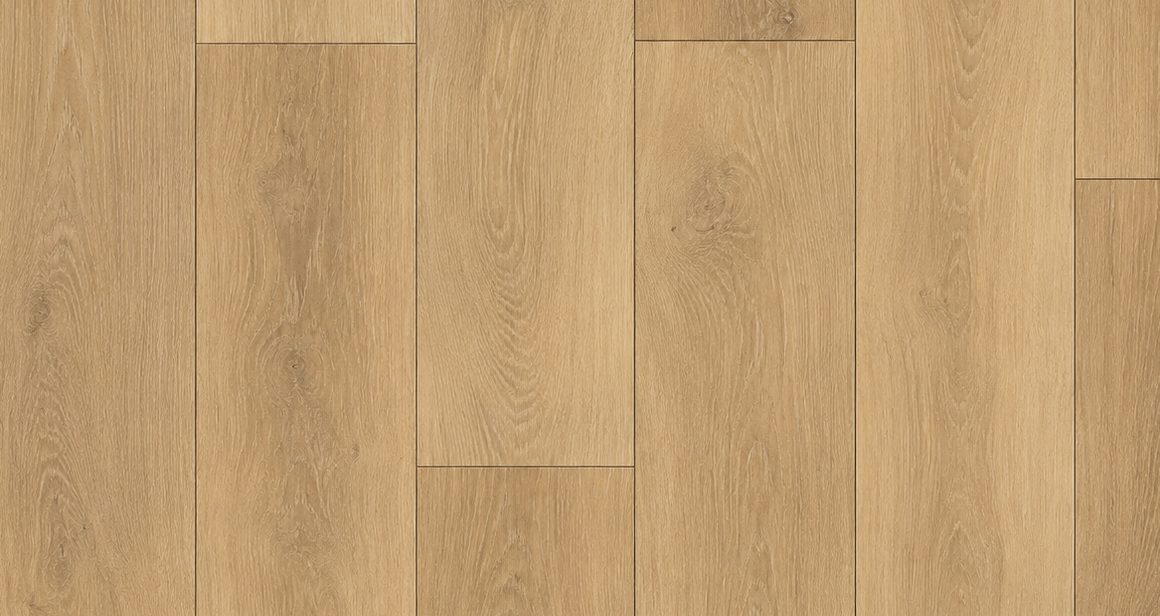
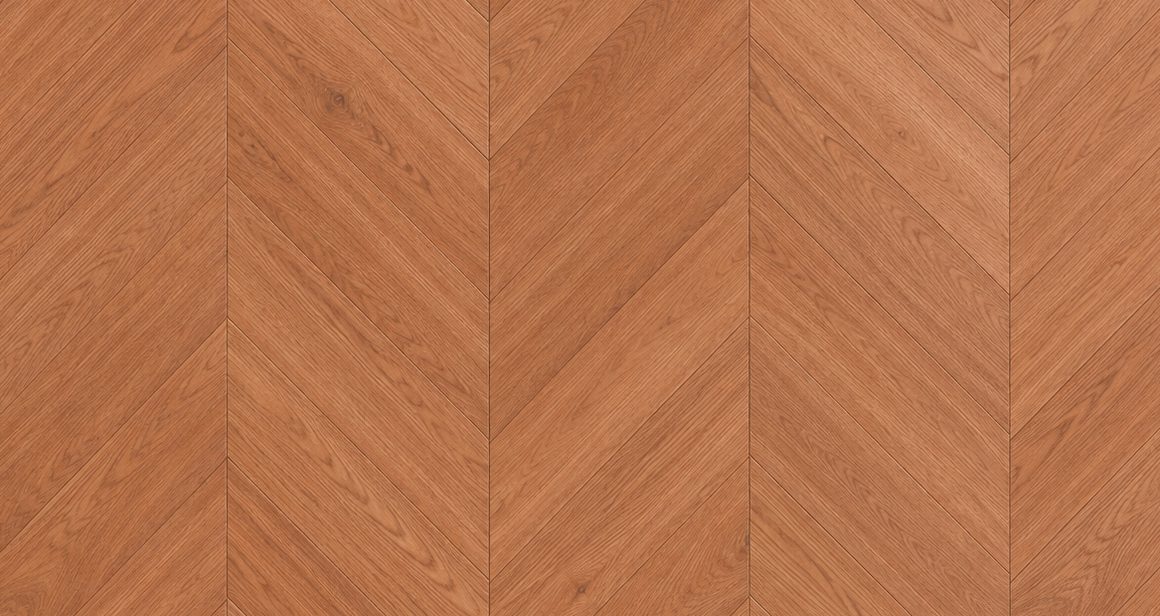
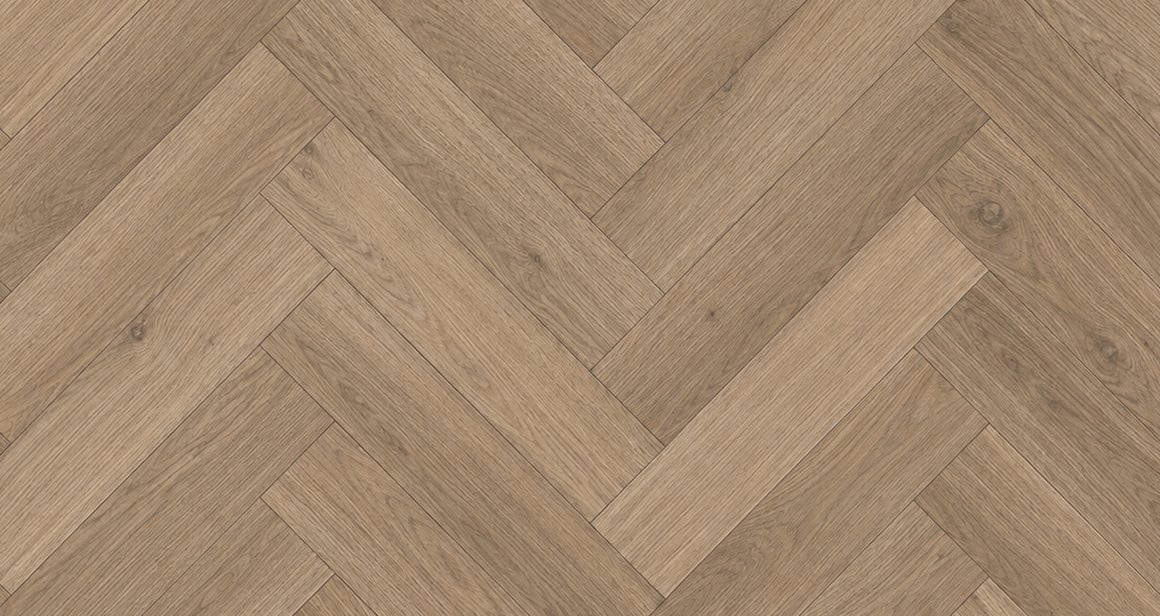
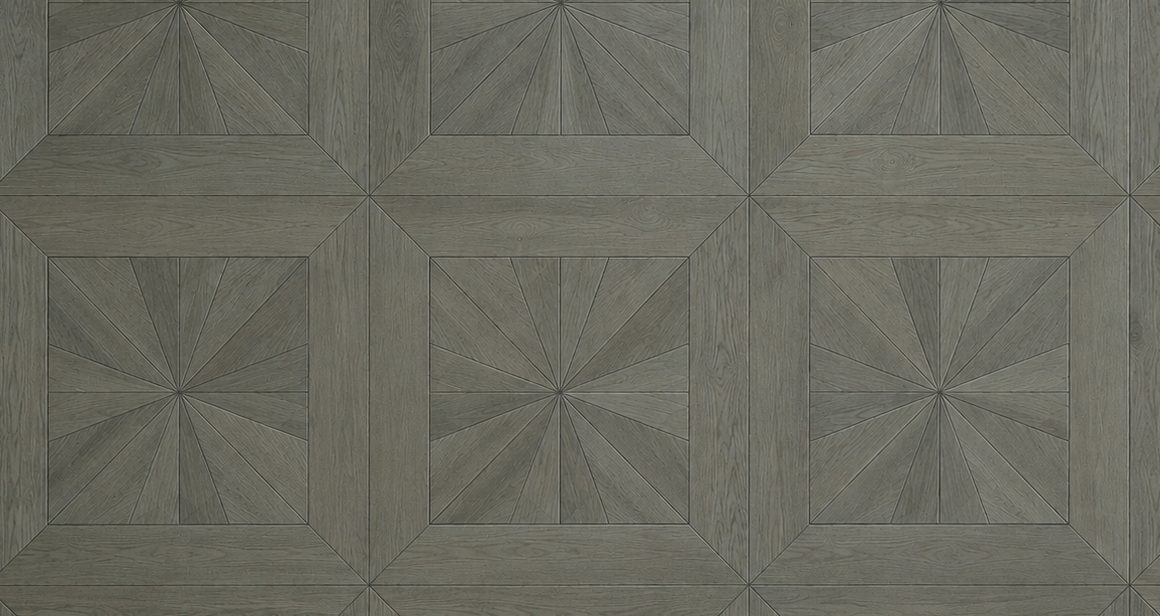
Flooring types: what each one is, and the standard behind it
Seven constructions, and the published standard that governs each one. The definitions and the standards below are not our summary of the trade — each is quoted from its source and linked, so you can check it.
- Engineered wood
- Solid wood
- Laminate
- LVT — luxury vinyl tile
- SPC rigid core
- Parquet, herringbone and chevron
- Porcelain tiles
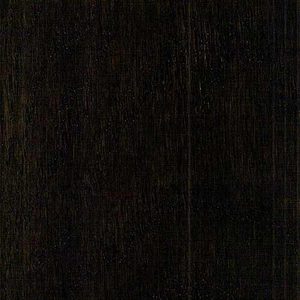
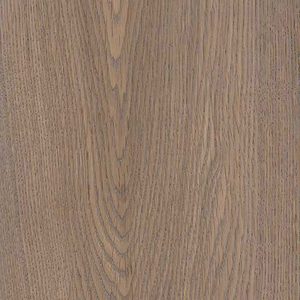
Engineered wood
Definition. A board with a real wood wear layer bonded to a cross-bonded plywood or HDF base, so the finished board moves far less with humidity than a solid board of the same thickness.
A real wood surface on a cross-bonded core. It is the wood that suits a heated screed, and the wear layer decides how often it can be sanded back.
BS EN 13489 — multi-layer parquet
BS EN 13489 is the product standard for multi-layer parquet elements, setting out their characteristics, requirements and test methods for internal use as flooring.
“This document specifies the characteristics, requirements and test methods of multi-layer parquet elements for internal use as flooring.”
Source: BS EN 13489:2023 - Wood-flooring and parquet. Multi-layer parquet elementsMoisture content at delivery — what EN 13489 requires
EN 13489, the product standard for multi-layer parquet, requires the moisture content of the elements to be between 5 % and 9 % at the time of first delivery, measured by the oven-dry method of EN 13183-1. The corresponding figure for solid parquet under EN 13226 was not available from a source we could read, so it is not stated here.
| Moisture content at first delivery, multi-layer parquet (EN 13489:2023, clause 4.1.2) | 5-9 % |
|---|
“The moisture content shall be between 5 % and 9 % at the time of the first delivery of the product.”
Source: EN 13489:2023 - Wood-flooring and parquet - Multi-layer parquet elements (SIST preview of the standard, clause 4.1.2 Moisture content)Wood over underfloor heating
UK trade-association guidance sets no blanket ban on wood over underfloor heating but ties it to a temperature limit, noting that some hardwood floor finishes are installed with a maximum floor surface temperature of 27 °C.
| maximum floor surface temperature for some hardwood finishes | 27 °C |
|---|
“For example, some hardwood floor finishes are installed with a maximum floor surface temperature of 27°C.”
Source: CFA Guidance Document — Beyond Installation: Guidance on Underfloor Heating (Contract Flooring Association)Solid wood
Definition. A board milled from a single piece of timber through its full thickness.
One piece of timber per board. The longest life of any floor if it stays dry and evenly heated, and the least tolerant of a damp subfloor or a heated screed.
BS EN 13226 — solid parquet elements
BS EN 13226 specifies the characteristics of solid parquet elements with grooves and/or tongues intended for internal use as flooring, covering elements with or without surface treatment.
“This European Standard specifies the characteristics of solid parquet elements with grooves and/or tongues for internal use as flooring. This standard is not applicable to panels made from elements for which a separate standard is in course of preparation.”
Source: BS EN 13226:2009 - Wood flooring. Solid parquet elements with grooves and/or tonguesBS EN 14342 — wood flooring and parquet: characteristics and marking
BS EN 14342 defines the characteristics, requirements and test methods for flat-surface wood flooring and parquet used as internal flooring, and sets the evaluation-of-conformity and marking rules for these products.
“BS EN 14342 defines and specifies the relevant characteristics and requirements of flat surface wood flooring products and parquets as well as the appropriate test methods for determination of their suitability for use as internal flooring, including fully enclosed public transport premises.”
Source: BS EN 14342:2013 - Wood flooring and parquet. Characteristics, evaluation of conformity and markingHow often a wood floor can be sanded
No trade-association or standards source found puts a number on how often an engineered wood floor can be sanded; the only sourced figure comes from a manufacturer, Kährs, which says engineered floors can be sanded up to four times depending on wear-layer thickness.
| sanding cycles, engineered wood floor (manufacturer statement) | up to 4 times |
|---|
“Depending on the thickness of the wear layer, they can be sanded up to four times, extending their lifespan significantly.”
Source: FAQ about flooring - KährsLaminate
Definition. A photographic decor layer over an HDF core, sealed under a transparent wear layer of resin. There is no wood at the surface.
A printed decor under a hard resin surface on a dense core. The standard that governs it sets the abrasion classes, and it is explicit that it does not cover areas subject to frequent wetting.
BS EN 13329 — laminate floor coverings
BS EN 13329 specifies the characteristics, requirements and test methods for laminate floor coverings with a surface layer based on aminoplastic thermosetting resins, including requirements for marking and packaging. It also contains a classification system based on EN ISO 10874 for areas and levels of use, and it does not cover areas subject to frequent wetting such as bathrooms, laundry rooms or saunas.
“BS EN 13329 specifies characteristics, requirements, and test methods for laminate floor coverings with a surface layer based on amino plastic thermosetting resins. BS EN 13329 specifies requirements for marking and packaging.”
Source: BS EN 13329:2016+A2:2021 | 31 Oct 2021 | BSI KnowledgeAC1 to AC6 — abrasion classes for laminate
EN 13329 classifies the abrasion resistance of laminate floor coverings in abrasion classes AC1 to AC6. The EPLF's own Environmental Product Declaration for DPL laminate floor covering states the property "Abrasion Class EN 13329" with the value range AC1-AC6.
| Abrasion classes under EN 13329 | AC1-AC6 |
|---|
“Abrasion Class EN 13329 | AC1-AC6 | -”
Source: Environmental Product Declaration - Direct Pressure Laminate Floor Covering (DPL Floor Covering), owner of the declaration: European Producers of Laminate Flooring e.V. (EPLF), decl. no. EPD-EPL-20210138-CBE1-ENEN ISO 10874 — use classes
EN ISO 10874 sets out a classification of floor coverings by area and intensity of use; the classes are 21, 22 and 23 for domestic use, 31 to 34 for commercial use and 41 to 43 for industrial use.
| Class 21 | Domestic moderate/light |
|---|---|
| Class 22 | Domestic general/medium |
| Class 23 | Domestic heavy |
| Class 31 | Commercial moderate |
| Class 32 | Commercial general |
| Class 33 | Commercial heavy |
| Class 41 | Industrial moderate |
| Class 42 | Industrial general |
| Class 43 | Industrial heavy |
“In EN ISO 10874 a classification system for different use classes is described, with references to the relevant product standards.”
Source: How to use the Floor Covering Standard Symbols (FCSS) — EUFCA, symbols per EN 15398LVT — luxury vinyl tile
Definition. A vinyl floor covering supplied in planks or tiles, with a printed decor under a clear wear layer.
A vinyl plank or tile with a clear wear layer over the decor. The thickness of that clear layer, not the total thickness, is what the class refers to.
ISO 10582 — heterogeneous poly(vinyl chloride) floor coverings
EN ISO 10582 specifies the characteristics of non-cushioned heterogeneous (multi-layer) PVC floor coverings in tile, plank or roll form, while EN ISO 10581 covers homogeneous PVC floor coverings in tile or roll form; both include a classification by intensity of use referring to ISO 10874 and requirements for marking.
“ISO 10582:2017 specifies the characteristics of non-cushioned, heterogeneous floor coverings, consisting of poly(vinyl chloride) (PVC), supplied in either tile or plank or roll form.”
Source: ISO 10582:2017 - Resilient floor coverings - Heterogeneous poly(vinyl chloride) floor covering - SpecificationsWear layer thickness classes for vinyl
EN ISO 10582 does not link heterogeneous PVC floor coverings to a wear layer thickness in millimetres per class. Its published scope states that the standard specifies the characteristics of non-cushioned heterogeneous PVC floor coverings and that it includes a classification system (see ISO 10874) based on the intensity of use, plus requirements for marking - so the class number (23, 31, 32, 33, 34) describes where a floor is fit to be used, not how thick its wear layer is.
| Basis of the classification system referenced by EN ISO 10582 (ISO 10874) | intensity of use |
|---|
“To encourage the consumer to make an informed choice, this document includes a classification system (see ISO 10874) based on the intensity of use, which shows where these floor coverings give satisfactory service. It also specifies requirements for marking.”
Source: ISO 10582:2017 - Resilient floor coverings - Heterogeneous poly(vinyl chloride) floor covering - Specifications (ISO catalogue page, abstract)BS EN 16511 — modular mechanical locked floor coverings
BS EN 16511:2023 specifies characteristics, requirements and test methods for multilayer mechanically locked modular floor panels with a wear-resistant decorative surface layer, supplied as tiles or planks for floating installation in domestic and commercial use.
“This document specifies the characteristics of multilayer mechanical locked floor covering with a wear-resistant and decorative surface layer supplied in panels (either tile or plank form). The floor panels are considered suitable for domestic and commercial levels of use and designed for floating installation.”
Source: BS EN 16511:2023 - Modular mechanical locked floor coverings (MMF). Specification, requirements and test method for multilayer modular panels for floating installationSee the lvt — luxury vinyl tile we stock · order a cut sample
SPC rigid core
Definition. A rigid-core vinyl floor whose core is a mineral-filled polymer, stiff enough to bridge small irregularities in the subfloor that a flexible vinyl would telegraph.
A rigid mineral-filled core under a vinyl surface. It moves less with temperature than a flexible vinyl and bridges a slightly uneven subfloor better.
What SPC rigid core actually is
According to the Multilayer Modular Flooring Association, SPC stands for Solid Polymer Core, whereas WPC stands for Wood Plastic Composite; both are listed as alternative core-layer materials for multilayer modular floor panels, the SPC core being a solid polymer compound and the WPC core a wood-polymer composite.
| SPC | Solid Polymer Core |
|---|---|
| WPC | Wood Plastic Composite |
| EPC | Expanded Polymer Core |
“Core layers can be wood composites such as HDF or cork, but also polymer or polymer composite materials such as PFC (Perfluorcarbone), natural fibre-reinforced plastics, WPC (Wood Plastic Composite), EPC (Expanded Polymer Core) and SPC (Solid Polymer Core); but also mineral-based substrates, e.g. MPC ("Mineral Plastic Composites").”
Source: Multilayer Modular Flooring in focus - MMFA (Multilayer Modular Flooring Association)BS EN 16511 — modular mechanical locked floor coverings
BS EN 16511:2023 specifies characteristics, requirements and test methods for multilayer mechanically locked modular floor panels with a wear-resistant decorative surface layer, supplied as tiles or planks for floating installation in domestic and commercial use.
“This document specifies the characteristics of multilayer mechanical locked floor covering with a wear-resistant and decorative surface layer supplied in panels (either tile or plank form). The floor panels are considered suitable for domestic and commercial levels of use and designed for floating installation.”
Source: BS EN 16511:2023 - Modular mechanical locked floor coverings (MMF). Specification, requirements and test method for multilayer modular panels for floating installationParquet, herringbone and chevron
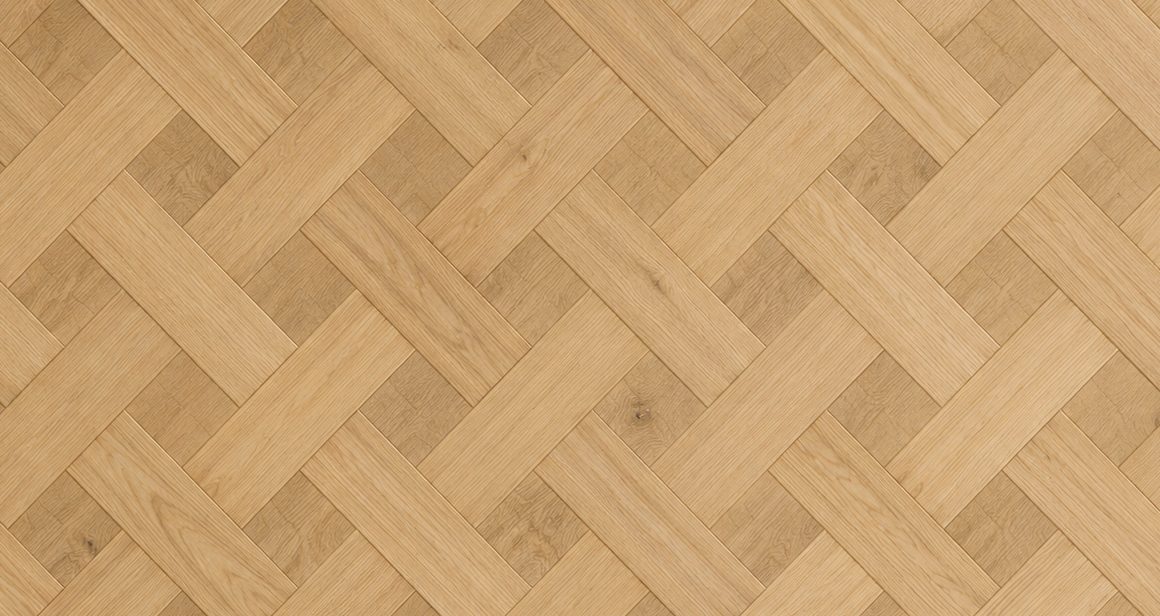
Definition. Rectangular blocks laid at a right angle to each other so the ends of one row meet the sides of the next, producing a staggered zigzag.
Small elements laid to a pattern. Available in solid and in engineered form, and the pattern is what makes the subfloor flatness and the set-out matter more than in a plank floor.
Herringbone and chevron — what the two patterns are
Herringbone is laid from rectangular blocks whose ends are cut square: set at right angles to each other and staggered, so that the end of one block meets the side of the next and the pattern reads as a broken zigzag. Chevron blocks have their ends cut at an angle - typically 45 or 60 degrees, depending on the manufacturer - so the ends meet on a continuous line and form a V. No published standard we could read defines the two patterns; the definitions here come from manufacturers and agree with each other.
| Herringbone: angle between adjacent blocks | 90 degrees |
|---|---|
| Chevron: typical end-cut angle (manufacturer-dependent) | 45 or 60 degrees |
“Herringbone flooring features rectangular wood planks arranged in a staggered zigzag pattern. Each plank meets the next at a 90-degree angle. In chevron patterns, the wood planks are cut at an angle, typically 45 or 60 degrees, so they meet in a continuous V-shape.”
Source: Havwoods - Herringbone vs. Chevron: Which Parquet Style Suits Your Space Best? · second sourceBS EN 13489 — multi-layer parquet
BS EN 13489 is the product standard for multi-layer parquet elements, setting out their characteristics, requirements and test methods for internal use as flooring.
“This document specifies the characteristics, requirements and test methods of multi-layer parquet elements for internal use as flooring.”
Source: BS EN 13489:2023 - Wood-flooring and parquet. Multi-layer parquet elementsCutting waste — how much extra to order
There is no published industry standard for cutting waste; the figures come from manufacturers' own guidance and they vary. Havwoods advises 8-12 % wastage for planks and 15-20 % for patterned floors such as herringbone or chevron. Quick-Step's UK guidance for laminate is 5 % extra in a regular room and 10 % in a room with many angles or curves.
| Wastage allowance, plank floors (Havwoods UK) | 8-12 % |
|---|---|
| Wastage allowance, herringbone or chevron (Havwoods UK) | 15-20 % |
| Extra to order, regular room, laminate (Quick-Step UK) | 5 % |
| Extra to order, room with many angles or curves, laminate (Quick-Step UK) | 10 % |
“For planks we typically advise on 8-12% wastage and patterned floors, such as herringbone or chevron, may need 15-20% wastage.”
Source: Havwoods UK - FAQs: How Much Wastage Shall I Encounter For? · second sourceSee the parquet, herringbone and chevron we stock · order a cut sample
Porcelain tiles
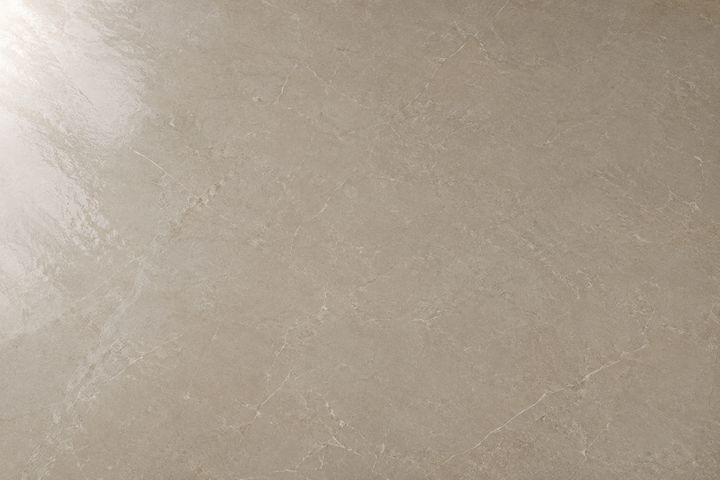
Definition. A dense fired ceramic with very low water absorption, which is what lets the same body be used outdoors in a British winter.
A dense fired tile that does not care about water. In a wet room the question stops being wear and becomes grip, which is measured rather than described.
Pendulum Test Value — how slip risk is assessed
HSE grades pedestrian slip potential from the pendulum test value (PTV): 0-24 is high slip potential, 25-35 moderate and 36 or above low slip potential, the pendulum coefficient-of-friction test being the subject of BS 7976 Parts 1-3.
| low slip potential | 36 + PTV |
|---|---|
| moderate slip potential | 25-35 PTV |
| high slip potential | 0-24 PTV |
“Table 1 Slip potential classification, based on pendulum test values (PTV) PTV High slip potential 0-24 Moderate slip potential 25-35 Low slip potential 36 +”
Source: HSE - Assessing the slip resistance of flooring (GEIS2)BS EN 13893 — slip resistance, dry conditions
EN 13893 sets the parameters for measuring the dynamic coefficient of friction of resilient, laminate and textile floor coverings walked on with shoes; the result is a dynamic coefficient of friction and the measurement is taken on dry surfaces only.
| measured quantity | dynamic coefficient of friction (u) |
|---|---|
| relief floor coverings included up to displacement volume | 4 cm3/dm2 |
“This European standard specifies the parameters for the measurement of dynamic coefficient of friction (u) on surfaces of resilient, laminate and textile floor coverings, usually walked on with shoes. Reliefed floor coverings with a displacement volume <= 4 cm3/dm2 are included.”
Source: BS EN 13893:2002 - Resilient, laminate and textile floor coverings. Measurement of dynamic coefficient of friction on dry floor surfaces (British Standard)Next: the standards and classifications in full, or what each room demands.