
Best Flooring for Homes with Dogs
Flooring advice for dog owners usually answers one question — what resists scratching — and stops there. That leaves out the two problems that cause more trouble in practice: water carried in on paws, and whether the dog can walk on the floor at all.
All three matter, and they do not point to the same answer.
Problem one: claws
A claw does not gouge a floor. It leaves fine surface scratches, thousands of them, concentrated where the dog turns — at the bottom of the stairs, in the doorway, beside the food bowl. What you notice is not an individual scratch but a dulled patch where the light no longer reflects evenly.
That means the decisive property is the surface finish, not the hardness of the material underneath.
Matt beats gloss, every time. A gloss finish shows every mark; a matt or brushed surface hides them.
Texture beats smooth. A brushed or hand-scraped timber floor absorbs scratching into a surface that was never uniform to begin with.
Oiled beats lacquered on timber, for one reason that matters more than any other: an oiled floor can be repaired in patches. A lacquered floor cannot — when it goes, it goes as a whole room.
A thicker wear layer on vinyl does the same job. A commercial-grade wear layer in a domestic house is not overspecifying when there is a dog.
Problem two: water
This is the one that quietly costs money. A dog comes in wet, shakes, and stands by the door. A water bowl gets knocked. None of it is a flood, and all of it is repeated daily for years.
A floor that takes on no water turns this into housekeeping. Laminate does not: water reaching a joint swells the core beneath the decor, and the damage is permanent and visible. In a house with a dog, laminate belongs only in rooms the dog does not use.
Problem three: grip, and this one is about the dog
A polished floor is hard for a dog to walk on, and much harder for an older or a large one. Splayed legs on a slippery floor are not just comical — over years they contribute to joint problems, and a dog that cannot get purchase will avoid rooms.
This is where very polished porcelain and high-gloss finishes fail even though they survive the claws perfectly. The floor wins and the dog loses.
Practical answers: choose a matt or textured surface, use runners on the routes the dog actually takes, and keep the claws trimmed — a long claw makes contact before the pad does, which is exactly when a dog slips.
What we would specify
Rigid-core vinyl with a commercial wear layer answers all three problems at once, and it is the recommendation for most households with a dog. Matt finish, no water uptake, and enough texture to give grip.
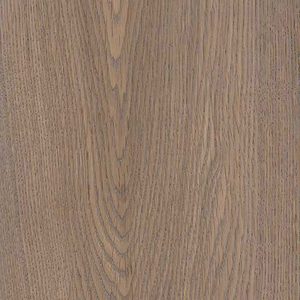
Engineered wood, brushed and oiled, is the answer where the floor has to be timber. It will mark — accept that — but it marks into a surface that was already textured, and it can be repaired locally rather than replaced.
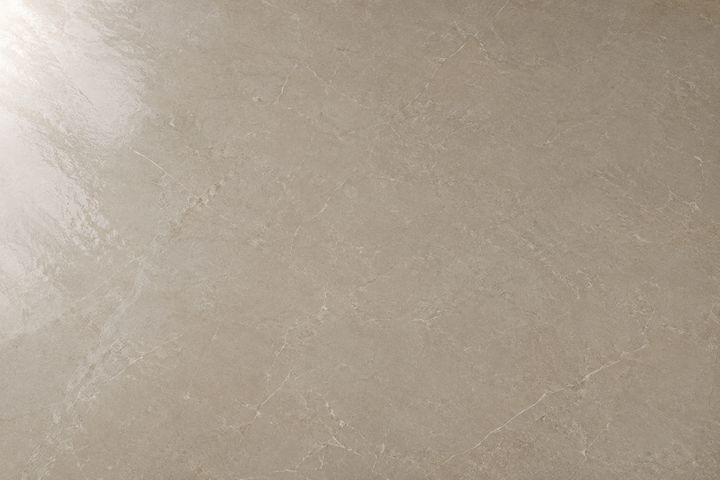
Porcelain tile in a matt or textured finish is effectively indestructible and easy to clean. Avoid polished. It is cold and hard, which some dogs like in summer and most dislike in winter.
Laminate only in rooms the dog does not enter.
The details that do most of the work
A mat at the door the dog actually uses, sized so all four paws land on it. A towel kept there. Claws trimmed. Felt pads under the furniture the dog pushes past. None of it is a flooring decision, and together it matters more than the difference between two good floors.
Common questions
Is engineered wood dog-proof?
No floor is, and any timber floor in a house with a dog will pick up fine surface marks. What makes engineered wood workable is the finish rather than the board: a brushed, oiled, matt surface hides scratching and can be repaired in patches. A high-gloss lacquered floor will show every mark and has to be resanded whole when it goes.
What is the most scratch-resistant floor for dogs?
Porcelain tile, by a wide margin — but specify a matt or textured surface rather than polished, because a polished tile is the hardest floor for a dog to walk on. If tile is not right for the room, a rigid-core vinyl with a commercial-grade wear layer is the practical answer and solves the water problem at the same time.
Why does my dog slip on the floor?
Usually a combination of a smooth, polished surface and claws that have grown long enough to make contact before the pad does. Trimming the claws often fixes most of it. Beyond that, runners along the routes the dog takes — hallway, past the sofa, up to the door — do more than changing the floor, and they can be added to a floor that is already down.
Two pages follow from here: what rigid-core vinyl actually is, and what a hallway floor has to survive — the room where a dog does most of the damage. The range is at LVT and rigid vinyl.
How much mud arrives on four paws depends a good deal on what is outside the door. See our coverage by town and region.