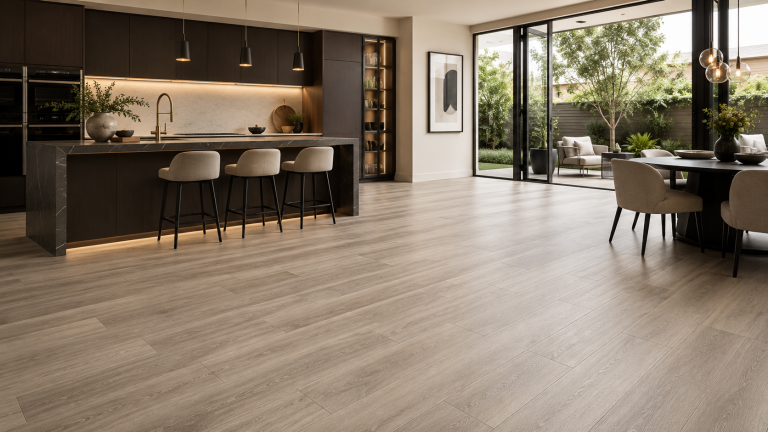
Humidity, Room Climate & Long-Term Floor Stability
Educate customers on expansion, contraction and the right indoor climate conditions year-round.
Browse our editorial collections and find your perfect floor.
Browse Collections
Educate customers on expansion, contraction and the right indoor climate conditions year-round.
Educate customers on expansion, contraction and the right indoor climate conditions year-round. The goal is simple: understand the decision, compare the right options and move into a practical next step without endless choices.
Flooring is not only affected by foot traffic, cleaning routines and installation quality. The indoor climate of a room also has a major influence on how well the floor performs over time. Temperature, air moisture and seasonal heating patterns all play a role in how timber-based floors settle, expand, contract and age.
This is especially important with wood flooring because timber is hygroscopic, which means it naturally absorbs and releases moisture depending on the surrounding environment. When the air becomes too dry, boards can contract and small gaps may appear. When humidity rises, boards can expand and put pressure on surrounding joins or edges. Good long-term floor stability is about managing these natural reactions well.
01Seasonal movement is normal, but excessive movement usually points to an unstable room climate.
02Floors perform better in homes where humidity and temperature stay reasonably balanced.
03Some flooring constructions are more dimensionally stable than others in changing conditions.
Core principleRelative humidity has a direct effect on timber flooring. In drier conditions, wood tends to lose moisture and contract. In more humid conditions, it can take on moisture and expand. This movement is a natural characteristic of real wood and wood-based flooring products, but the scale of movement depends on the board construction, installation method, width of the planks and the stability of the indoor environment.
Engineered wood flooring is often chosen because its layered construction helps reduce extreme movement compared with many solid wood boards. However, even engineered planks still benefit from a well-managed indoor climate. Large fluctuations can still affect board joints, finish performance and the visual consistency of the floor.
In many homes, the most noticeable changes happen between winter and summer. During colder months, central heating can dry the air significantly, which may encourage timber boards to contract slightly. In warmer seasons, higher air moisture can allow boards to expand again. This is one reason why some homeowners notice fine gaps in winter that become less visible later in the year.
Seasonal movement does not automatically mean there is a problem. It becomes more concerning when movement is excessive, persistent or combined with issues such as cupping, edge lift, creaking caused by pressure build-up, or visible stress around thresholds and skirting.
The most floor-friendly indoor environment is one that avoids sharp swings in both humidity and temperature. While exact acceptable ranges can vary by manufacturer, finish and product construction, the general principle is stable, comfortable living conditions rather than overly dry or highly humid extremes.
Homes that are kept at a steady ambient temperature and supported with sensible ventilation often provide the best conditions for timber flooring. This matters not only for the boards themselves, but also for adhesives, joints, trims and long-term finish quality.
| Climate factor | Why it matters | Best practice |
|---|---|---|
| Relative humidity | Influences whether boards absorb or release moisture. | Keep humidity as stable as possible and avoid extreme indoor dryness or dampness. |
| Room temperature | Strong temperature shifts can stress the floor, especially with heating systems. | Maintain a consistent, comfortable living temperature. |
| Ventilation | Poor airflow can contribute to trapped moisture or imbalanced room conditions. | Ventilate regularly without creating unnecessary extremes. |
| Underfloor heating | Can dry boards out if temperatures are pushed too quickly or too high. | Increase and reduce heat gradually and follow flooring guidance carefully. |
| Seasonal lifestyle habits | Heating, drying laundry indoors and poor airflow can all influence floor performance. | Monitor the indoor environment during winter and transitional seasons. |
Supporting floor stability does not usually require complex interventions. In most homes, it comes down to better environmental consistency, careful heating habits and choosing the right flooring product for the way the room is used.
Different flooring constructions react differently to environmental change. Solid wood flooring offers a beautiful authentic feel, but it can be more sensitive to moisture variation than a high-quality engineered wood floor. Engineered wood is often preferred in modern homes because its layered construction is designed to offer improved dimensional stability while still delivering a real wood surface.
In spaces where room climate may vary more, such as open-plan extensions, homes with underfloor heating or areas that experience stronger solar gain, the construction of the floor becomes especially important. Product thickness, core design, board width and installation method can all influence performance.
Yes. Real wood and wood-based flooring naturally respond to changes in air moisture. Some movement is normal and expected.
In many homes, yes. Engineered wood is generally designed to offer improved dimensional stability because of its multi-layer construction.
Very dry indoor air can increase shrinkage and make small seasonal gaps more visible, especially during the heating season.
Higher moisture levels can encourage expansion and may increase the risk of pressure, swelling or localised distortion in more sensitive areas.
It can if not managed correctly. Underfloor heating works well with many floors, but gradual temperature changes and correct product selection are essential.
Related guidesFirst the decision filters that matter — then the routes where each choice makes sense.
Order samples in your light, compare matching collections or speak to our team for a tailored direction.
Expert insights
Explore our resource hubs for flooring guides, design articles, real projects and trade support.
In-depth guides to help you choose, install and maintain your perfect floor.
Explore
See real project examples, transformations and customer flooring stories.
Explore
Trade pricing, project guidance and premium UK supply for designers and contractors.
Explore